|

|






|
Somalia is a fragmented country that has suffered over twelve years of violent civil war. More than half the population of Somalia is under 18. The current generation of young people in Somalia have known conflict and hardship for most of their lives. Most are out of school, either illiterate or semi-literate, with little hope for the future. Many are displaced and have witnessed and sometimes participated in violence. |
|
Yet in spite of overwhelming odds, these same young people have often demonstrated enormous resilience and capacity to survive. With adequate support, guidance and skills, they can provide the foundation for building peace and rebuilding lives and communities. Their participation in decision-making processes of concern to them - in particular where the future of their country and peace building is at stake - can empower them to be agents of positive change in their society.
Somali youth are fast becoming leaders in their devastated society, using youth groups to give voice to the concerns of their generation. More than 200 youth groups have been formed by young people in Somalia and, in many respects, these youth groups are the same as others around the world - they are places where youth get together to play sports, make music or just simply hang out with friends. However, they are unique in their focus on community development. Youth from these groups are promoting greater community awareness about issues such as female genital mutilation (FGM), disarmament and HIV/AIDS. The youth in Somalia are moving forward and becoming leaders in one of the most challenging environments in the world.
Until now however, these young people have not been able to have their voices adequately heard in the process, nor to acquire the necessary information and skills to be able to contribute meaningfully to conflict prevention, conflict resolution and sustainable peace building. UNICEF and CRD (Center for Research and Dialogue) are working to help them develop as leaders and learn to articulate their concerns in a meaningful and powerful way. This project proposes the development of youth groups from two angles - training in peace building, mediation and advocacy.
The training in peace building and mediation will provide opportunities for a core group of youth leaders to strengthen their participation in the community-based peace process. The youth broadcasting initiative will give members of youth groups both skills in a progressive and exciting industry, but will also focus heavily on how they use those skills to advocate for a more peaceful society and for social change.
ISSUE - Somalia in conflict
Somalia continues to have a complex and volatile political, social and economic landscape. Over a decade after the collapse of the central government, the country remains beset by conflict and division, prone to drought, vulnerable to flood and presenting some of the worst Millennium Development Goal indicators in the world. The trend within the country is divergence, with some areas experiencing political development and economic recovery, while others continue to be plagued by crises and emergencies. Many among the population of 6.4 million struggle to meet their basic needs, particularly children, women and marginalised groups.
The basic causes contributing to the situation of children and women are three-fold. First, the majority of social services and formal infrastructure in the country has been destroyed by the years of civil war. Second, there is a void of technically qualified personnel to provide services and ensure that children's basic rights are fulfilled. Finally, the Somali population is widely dispersed, sparse and often mobile, making interventions complicated and limiting access for large segments of the population.
In addition, there are a number of underlying causes that hinder humanitarian and development efforts. Violence and armed conflict continue in large parts of the country, and the many peace processes by and on behalf of Somalis have so far failed to create a peaceful and unified environment. While relative stability exists in the Northwest zone of 'Somaliland' and parts of the Northeast zone of 'Puntland', the central and southern areas lack political stability and continue to see localised-armed conflict. There is neither central government structure nor related legal institutions in the country, from which national policies, programmes and laws can be uniformly developed and advanced. Where forms of regional and local governance do exist, they are nascent and fragile. Clan loyalties characterise many of these structures and often are a divisive force when seeking to create stability and unity among the many groups.
The economic and ecological environment within Somalia is affected by a number of factors. Unregulated commercialisation, a two-year ban on exports of livestock, land degradation and recurring flood and drought have eroded traditional livelihood structures, and have contributed to an increase in the levels of absolute poverty. Increasing inequities within Somali society, continued emergence of the urban poor and long term internally displaced settlements are other consequences of this trend. At the same time, cultural norms influenced by the prevailing knowledge, attitudes and practices among communities continue to have a direct impact on the fulfilment of the rights and the protection of Somali children.
Security Situation in 2002 and into 2003
During 2002, the Northwest Zone offered an environment of relative peace and stability. Following the death of the long term President, Mohammed Ibrahim Egal, a peaceful transition of authority took place to his deputy. In December, municipal elections were also held peacefully, although tensions are high with neighboring Puntland. In the Northeast Zone of 'Puntland' (NEZ) the constitutional crisis continued from the last quarter of 2001 leading to the return of the former Puntland President, Abdullahi Yusuf.
Increasing instability in the Central and Southern Zone (CSZ) over the past year has posed major challenges to programme acceleration. The trend presents serious threats to achievements to date. Some areas risk reversals in gains due to access problems. Even those locations considered to be "safe havens" one year ago, such as Baidoa, have been affected and are presently too insecure for expanded international and national staff presence. In Gedo region, 6,000 people returned to their home districts following displacement towards Kenya in May 2002. However, the continuing presence of landmines on key roads and a fragile cease fire between rival sub-clans underline the volatility of the situation in this region.
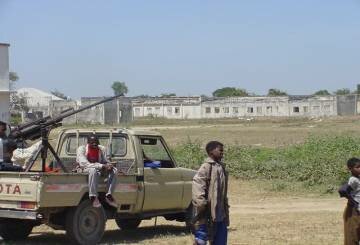 |
Mogadishu continues to be unstable, divided by inter-clan and inter-factional conflict. An increase in kidnapping by freelance militia was witnessed throughout the year. In 2002, five UN national personnel, including one UNICEF staff member, were kidnapped and subsequently released. |
ACTION
The ongoing peace process is a key opportunity to carve out a space where children can learn about their role as responsible and active Somali citizens, articulate and prioritize their demands towards Somali leaders, engage with the main actors and have their voices heard. Even though the outcomes of the formal peace process are not yet known, there is a need for a strengthened involvement of civil society in reconciliation efforts so as to ensure a more comprehensive and sustainable peace. Young people are a vibrant part of Somali civil society and can contribute positively and constructively to this process.
UNICEF Somalia, through the youth education, development and participation programme (YEDP) is already providing holistic development, learning and participation opportunities for out of school youth aged between 14 and 18 years. This programme, initiated in 1999, uses sports and recreational/cultural activities as the entry point. It places emphasis on strengthening the country's loosely organised youth groups through training and capacity building interventions aimed at turning them into organisationally focussed, effective and efficient entities. UNICEF Somalia is also implementing several activities in the field of the protection of young people against violence, abuse and exploitation. Indeed, youth are most vulnerable to recruitment and use as child soldiers, to sexual and gender-based violence, as well as to conflict-related violence, and activities and advocacy initiatives have been undertaken to prevent such practices and mitigate their effects to who have suffered such practices.
In order to build on the success of the youth development and protection, UNICEF will work toward the following specific objectives, activities and methodologies:
Overall Goal of Project
Empower the young people of Somalia through provision of peace building and conflict resolution (PB+CR) life-skills to ensure their full participation in community-based peace processes leading to a reduction of violence and peaceful means of conflict resolution.
Specific Objectives
· Provide training and facilitation skills in peace building and conflict resolution to a core group of 25 Somali youth leaders through Training of Trainers/Facilitators (TOT/TOF) workshops.
Equip 250 Somali youth from across the country with peace building and conflict resolution life-skills thereby increasing their opportunities to participate in community-based peace process.
Facilitate the establishment of an effective network of Somali youth committed to peace throughout the country, providing a permanent forum for their continuous engagement in the Somali peace process.
Activities
Five conflict-resolution and peace-building training workshops (of five days each) conducted throughout Somalia with approximately 30 youth participants, 50 percent of which are girls, and with particular attention to the participation of young people belonging to disadvantaged groups (internally displaced children and children belonging to minorities).
At the end of each training, conduct a one and a half day training for trainers for the five best participants from each workshop (about 50 percent of which will be girls) to give them the necessary knowledge and skills to organise similar training workshops for other youth groups.
Support the organization and implementation of five additional conflict resolution and peace building training workshops run by young people themselves, with approximately 20 youth participants in each workshop, at least 50 percent of which are girls.
Organize a series of consultative meetings between a key group of young people, selected from the workshops, and Somali leaders in order to present concerns, priorities and requests of young people and agree on the modalities of how young people can participate in the reconstruction of Somalia (e.g. plan of action / Youth parliament, etc.).
Provide support to the establishment of a youth peace network and the first few months of its activities, with a view to build the capacity of the young people who will be responsible for sustaining the initiative.
Methodology
The training workshops are conducted in a highly participatory manner, with use of multimedia training tools and methodology.
Training modules, in both English and Somali, will be developed on the basis of already existing conflict resolution and peace building training, in particular those used by UNICEF's partner - the Center for Research and Dialogue (CRD) in Mogadishu. The modules have been used in different activities, including in the ELMAN child soldiers rehabilitation and reintegration project (which is a joint collaboration between ELMAN Peace Centre and UNICEF, in Mogadishu, Kismayo and Merca).
The training methodologies, as well as the training modules, are respectful of Somali traditions and culture.
The development of the training modules, as well as the strengthening of the capacity of the local partner to the project - CRD - will be facilitated by an internationally recognized and known partner in the field of conflict transformation and resolution, TRANSCEND (Peace and Development Network for Conflict Transformation by Peaceful Means). It is planned that capacity building in the field of training development and facilitation will also benefit a broader core of key Somali civil society partner organisations, which are undertaking similar grass-roots projects on peace building and conflict resolution. The objective of this partnership with an international actor is to strengthen the local capacities in order to conduct this project, and similar initiatives throughout Somalia.
Profile of the Target Group
Approximately, 250 young people between the ages of 14 and 18 (50 percent of which are girls) will benefit from the training. There will be a proportionate representation from urban, rural and pastoral / minorities and disadvantaged groups. The young people will come from the Central and Southern and Northeast parts of Somalia. Some young people from the Northwest will also be invited to participate. The young people will be selected on the basis of their previous participation in training and activities organised by the UNICEF youth education and development programme.
About 25 young people will be trained in training/facilitation skills in peace building and conflict resolution for future workshops.
The 250 young people who will participate in this project will be its primary beneficiaries. However, the 25 young people selected for training of trainers will be encouraged to conduct further training workshops in order to reach a maximum number of young people. Collaboration with Somali and international partners will be strengthened to ensure their support for the initiative and further support for training workshops and a youth peace network.
Designed and hosted By The Web Technology